
Security and Innovations
Solvents are found in many workplace environments: cleaning, degreasing, painting, maintenance, manufacturing and laboratories. However, their effectiveness comes with a specific risk: many solvents are flammable and their vapours can form an atmosphere capable of igniting in the presence of an ignition source. Preventing fire risk therefore does not rely on a single measure. It requires a comprehensive approach combining the reduction of quantities present at the workstation, control of ignition sources, ventilation, suitable equipment for storage and handling, as well as a clear organisation of product flow.
Static electricity and sparks: why earthing is essential when handling solvents
When a flammable solvent is decanted, shaken or moved, an electrostatic charge may build up. If this charge accumulates on an isolated conductive piece of equipment, it may cause a discharge in the form of a spark. In the presence of flammable vapours, this spark can act as a source of ignition. Earthing and equipotential bonding of conductive equipment are therefore essential preventive measures. In the relevant installations, conductive equipment used with or situated near solvents must be able to dissipate electrostatic charges in order to minimise the risk of sparks.
The choice of container also plays an important role. When handling flammable solvents, it is preferable to minimise the use of open or unsuitable containers and to prioritise containers designed for this purpose, which help to reduce the risks of leakage, spillage and exposure to vapours. When decanting, prevention must therefore be considered as a holistic approach: suitable equipment, control of static electricity, minimisation of ignition sources and organisation of the workstation. Earthing alone does not provide an absolute guarantee against all electrostatic phenomena; it forms part of a comprehensive prevention strategy.
From safety drums to safety cabinets: how to organise a compliant workflow?
Safety begins long before the solvent is used. It must be integrated into the entire product lifecycle: receipt, storage, provision, use, and finally the management of containers and waste. A key rule is to keep only the quantities necessary for the task at the workstation. The aim is to minimise as far as possible the quantity of flammable liquid present in the work area and thus limit the potential consequences of an incident.
EN 14470-1: a particularly rigorous standard for safety cabinets
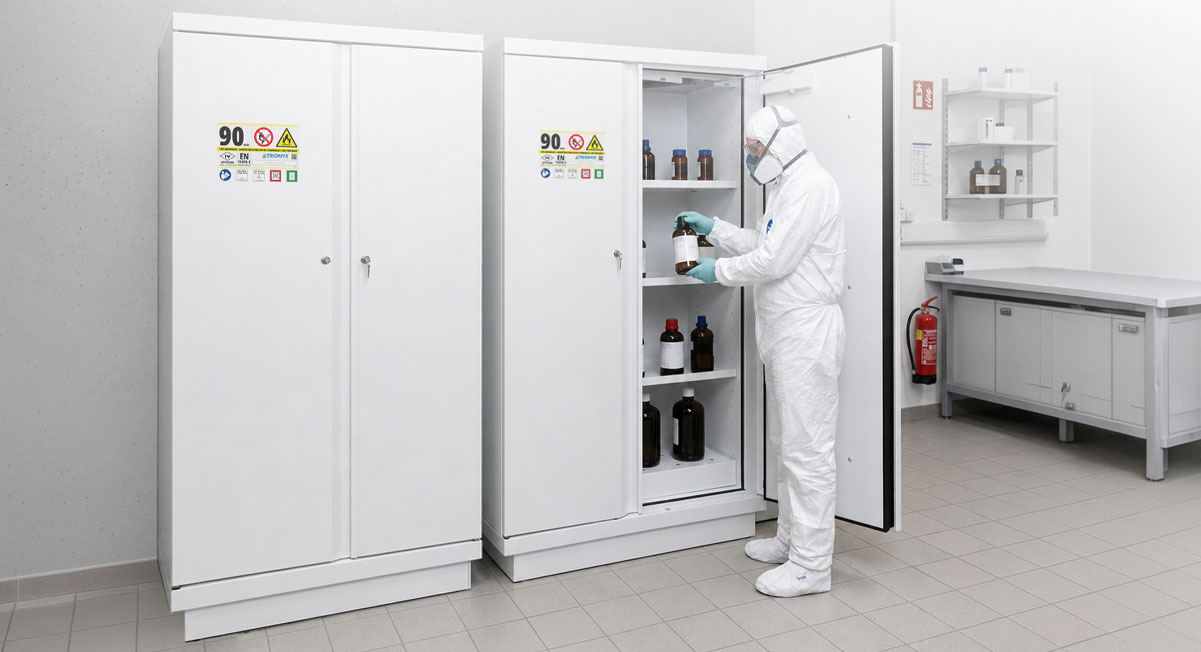
For the storage of flammable liquids, NF EN 14470-1 is a key reference. This standard governs fire-resistant safety storage cabinets intended for flammable liquids and, in particular, sets out requirements relating to their construction, their fire resistance, their classification and their performance in specific tests. Its rigour is based on a key principle: a cabinet cannot simply be described as ‘fire-resistant’ on the basis of its materials or its appearance. The performance of the entire structure must be demonstrated through tests defined by the standard. Discover our [comprehensive guide to the EN 14470-1 standard] to check the compliance of your installations.
Organising the workflow around the cabinet
The safety cabinet then allows the storage of flammable products to be separated from the general handling area.
It must be selected according to the products in question, the quantities stored and the specific constraints of the installation. The workflow can then follow a simple logic: store the main volumes in a dedicated area, remove only the quantity required, transport the product in a suitable container to the workstation, then return the container to storage after use. This organisation limits the quantity of flammable products present simultaneously in work areas and reduces the risks associated with repeated handling.
Waste management must follow the same logic. Rags, absorbents or containers that have been in contact with solvents must not be treated as mere ordinary waste: their storage must be organised in such a way as to minimise the risks of fire and contamination of the workstation.
Finally, choosing a cupboard that meets the requirements of standard NF EN 14470-1 does not exempt the employer from carrying out a comprehensive assessment of the workstation. The employer must also take into account the properties of the products, the quantities present, ventilation, potential sources of ignition and the actual conditions of use.
Reducing the risk at source: ventilation, quantities and best practice
Preventing fire risks associated with solvents primarily involves reducing the likelihood of a flammable mixture coming into contact with an ignition source. This entails limiting vapour emissions, in particular through appropriate ventilation and, where relevant, extraction at source. Keeping the workstation clean and uncluttered also helps to prevent a spill or build-up of flammable products from turning an incident into a fire. It is also essential to control the various sources of ignition: naked flames, hot work, unsuitable electrical equipment, tools capable of producing sparks, or electrostatic discharges.
Beyond equipment, operator training remains crucial. Every user must be familiar with the properties of the products they handle, storage rules, spill response procedures and the actions to take to avoid any source of ignition. The aim is therefore not simply to store solvents away: it is to design a workstation where every step, from collection to waste storage, helps to reduce the risk.
Our ventilation and filtration units are designed to help professionals manage the vapours and fumes generated when handling solvents. By capturing harmful vapours via their activated carbon filters, they help maintain a better-controlled working environment and limit the build-up of vapours at the workstation. As part of a comprehensive approach to prevention and environmental protection, our fume cupboards offer a technical solution specifically designed for workstations exposed to chemicals.
➡️ Discover our range of cabinets for flammable products compliant with NF EN 14470-1.
Make your working environment safer with our cabinets for flammable products.
➡️ The ventilation cabinet: a practical solution to enhance safety
Protect users from toxic fumes
➡️ Join us at Préventica Lyon 2026
Meet our teams at the Préventica Lyon trade fair, from 6 to 8 October 2026 at Eurexpo. Come and discover our solutions and discuss your occupational risk prevention challenges with our experts.